Spain’s tapestry of cultures is woven from 17 vibrant threads called autonomous communities. Each, akin to miniature states, possesses its own executive, legislative, and judicial powers, shaping its unique identity. Yet, this wasn’t always the case.
Fifty smaller provinces once stitched together the Spanish landscape, but in 1978, a reorganization saw the rise of four “historic communities” – Catalonia, Basque Country, Galicia, and Andalusia – reunified after a period of separation.
Language further enriches this diverse mosaic. While Spanish reigns supreme, six communities proudly share their official tongue with another: Catalan (and its Valencian dialect) in Catalonia and Valencia, Galician in Galicia, and Basque in the Basque Country and parts of Navarre.
Embark on a journey through these distinct regions:
- Andalusia (Andalucía), sun-kissed by flamenco rhythms and Moorish whispers, with Seville as its vibrant heart.
- Aragon (Aragón), cradled by the Pyrenees, whispers tales of ancient kingdoms from its capital, Zaragoza.
- Asturias, emerald green and dotted with charming villages, finds its center in Oviedo.
- Balearic Islands (Islas Baleares), where turquoise waters lap against golden shores, are governed from sun-drenched Palma de Mallorca.
- Basque Country (País Vasco), a land of rolling hills and a unique spirit, finds its rhythm in Vitoria.
- Canary Islands (Islas Canarias), volcanic gems scattered across the Atlantic, have two capitals sharing the reins: Las Palmas de Gran Canaria and Santa Cruz de Tenerife.
- Cantabria, kissed by the Bay of Biscay, finds its anchor in Santander.
- Castile-La Mancha (Castilla- La Mancha), windswept plains dotted with windmills, finds its soul in Toledo, the City of Three Cultures.
- Castile and León (Castilla y León), steeped in medieval grandeur, is guided from Valladolid.
- Catalonia, where cosmopolitan Barcelona meets rugged coastlines, celebrates its heritage with Catalan.
- Extremadura, a land of conquistadors and hidden gems, finds its center in Mérida.
- Galicia , Celtic whispers and dramatic cliffs, are echoed in Santiago de Compostela.
- La Rioja, a land of rolling vineyards and vibrant festivals, finds its heart in Logroño.
- Community of Madrid, (Comunidad de Madrid) Spain’s bustling epicenter, pulsates with life around its namesake capital Madrid.
- Region of Murcia (Región de Murcia), kissed by the Mediterranean, finds its sun-drenched center in Murcia.
- Navarre (Navarra), where mountains meet fertile plains, shares its Basque tongue in parts with its northern neighbor, Pamplona guiding the way.
- Valencian Community (Comunidad de Valencia), where paella scents the air and citrus groves bloom, celebrates its heritage in its capital Valencia.
Beyond mainland Spain, two “autonomous cities,” Ceuta and Melilla, proudly stand on the North African coast, each a microcosm of Spanish culture interwoven with local influences.
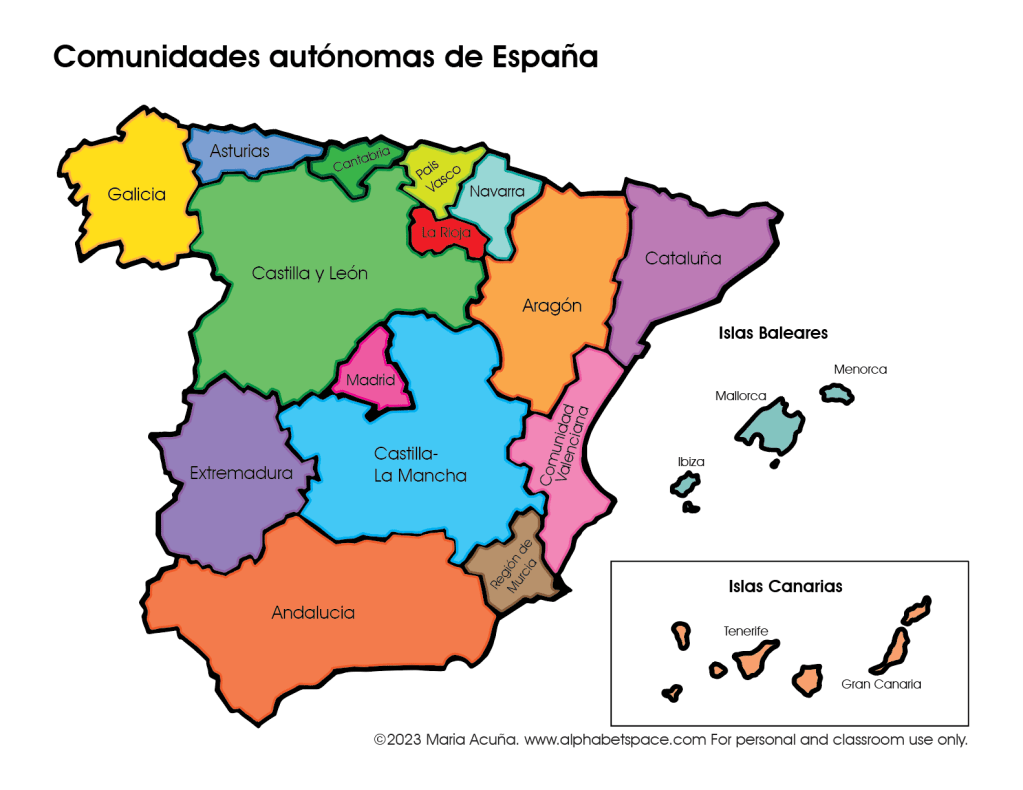
This is a map I made of the Autonomous Communities of Spain. You can use it as a poster for your classroom! High Resolution PDF follows it.
Delve into this vibrant tapestry of Spain, where every autonomous community adds its unique thread to the rich cultural fabric of this captivating nation, with an activity packet I created HERE. The packet contains a variety of coloring, writing and puzzle activities that can be adapted for children from Preschool through High School and beyond! I even included and activity that helps one learn the provinces within every community of Spain. Below is a preview:


I will work on one in English … eventually!
The following video is about the Autonomous Communities. I think it is for 5th graders and up… it was entertaining, historical and more importantly pretty accurate.
 Alphabet Space
Leave a comment